Ethics

future of ai literacy education

Future of AI Literacy Education

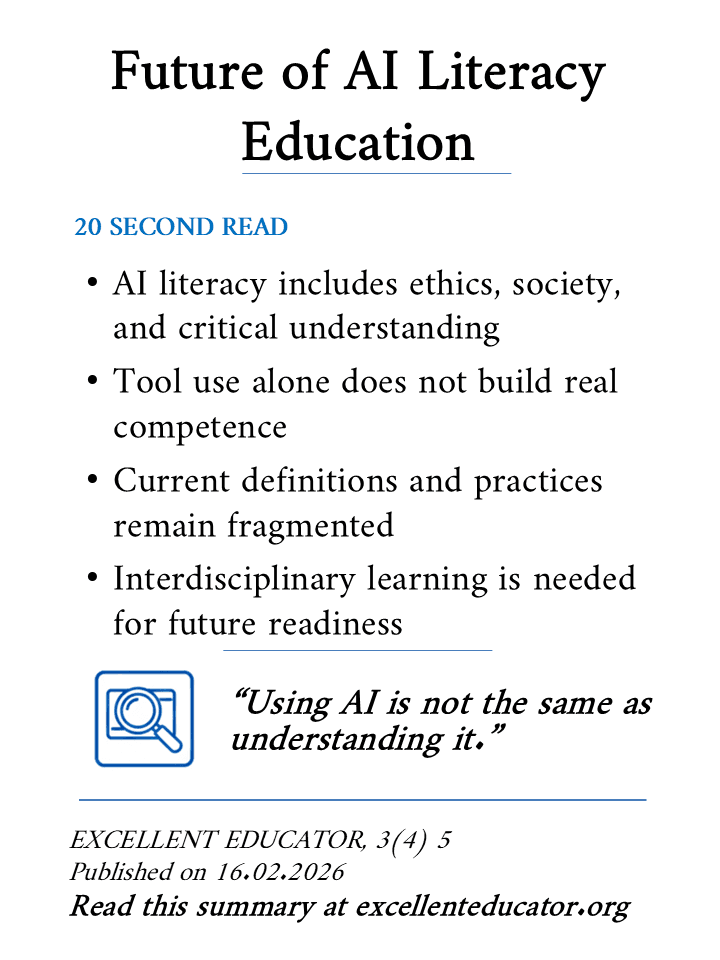
Future of AI Literacy Education Excellent Educator, Volume: 3, Issue: 4, Page: 5 Summary Academic Insights This summary explains why AI literacy is central to the future of education with AI. AI literacy is not limited to learning how to use tools. It includes technical knowledge, ethical awareness, and social understanding. The review analyses a […]
Future of AI Literacy Education Read More »

designing ai literacy through students

Designing AI Literacy Through Students

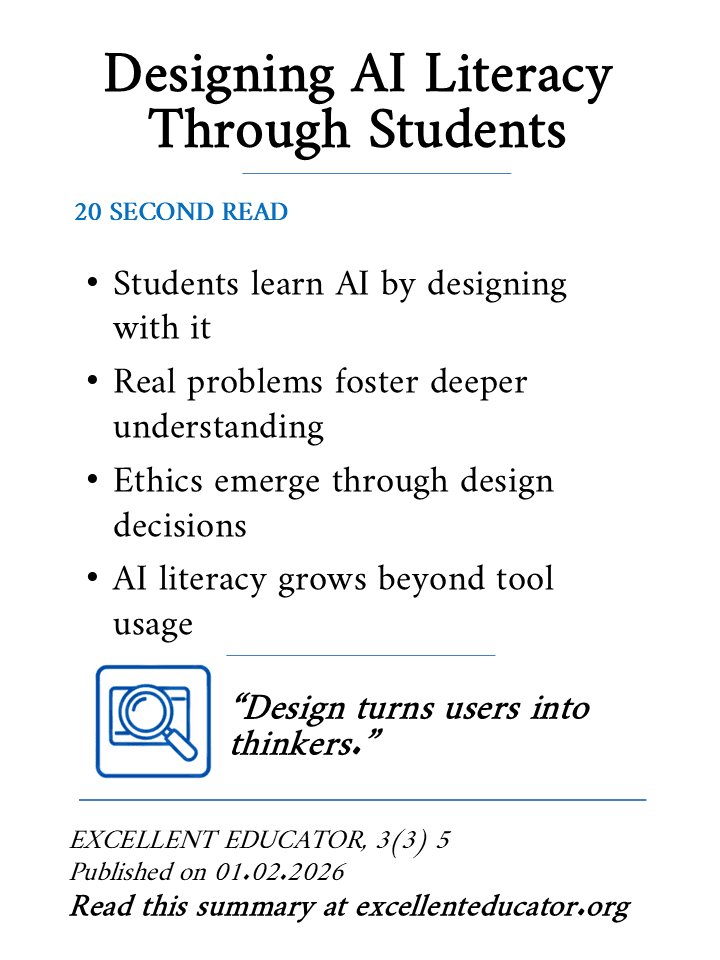
Designing AI Literacy Through Students Excellent Educator, Volume: 3, Issue: 3, Page: 5 Summary Academic Insights This design-based research study introduces the “Students as AI Literate Designers” framework and evaluates its implementation with Grade 5 learners. The framework positions students as active designers of AI-based solutions rather than passive users. Findings show improvements in AI

Designing AI Literacy Through Students Read More »

ai literacy for young learners

AI Literacy for Young Learners

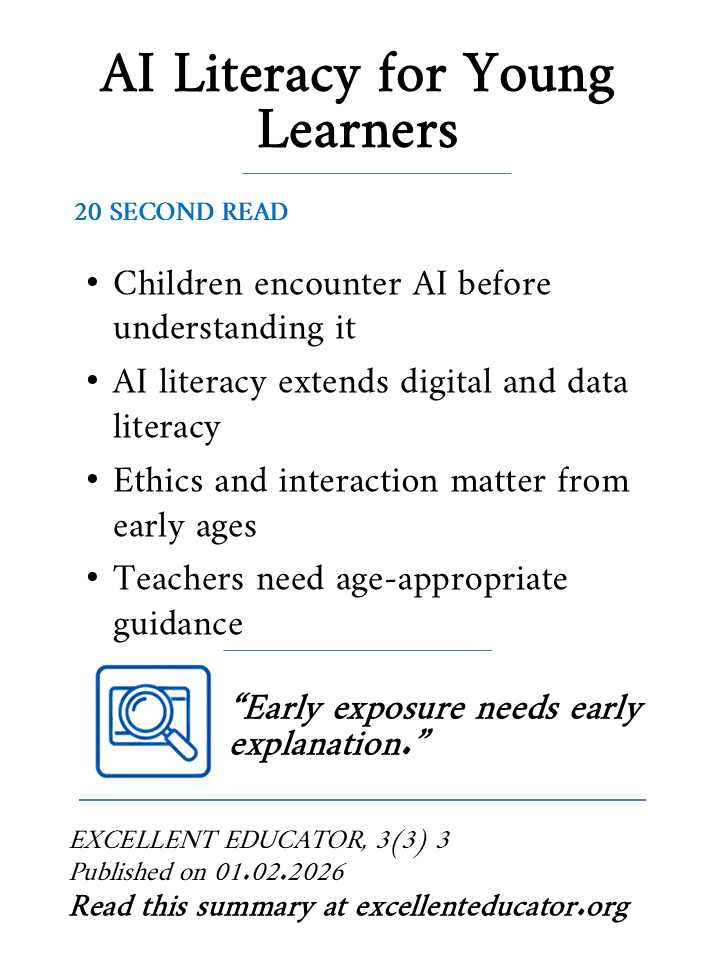
AI Literacy for Young Learners Excellent Educator, Volume: 3, Issue: 3, Page: 3 Summary Academic Insights This systematic review synthesises 25 empirical studies examining how AI literacy is conceptualised, taught, and assessed in primary education. The review analyses learning objectives, pedagogical approaches, instructional tools, and reported learning outcomes. AI literacy is framed as an extension

AI Literacy for Young Learners Read More »

Integrating GenAI in Schools​

Integrating GenAI in Schools​ Excellent Educator, Volume: 2, Issue: 23, Page: 1​ Summary of Reiter et al (2025) This study captures how 76 Canadian educators envision generative AI transforming school teaching and administration. After attending a GenAI seminar, teachers reflected on how AI might reduce workload, support differentiated instruction, create diverse learning materials, and strengthen

Integrating GenAI in Schools​ Read More »

Teens’ Ethical Views on AI​​

Teens’ Ethical Views on AI​ Excellent Educator, Volume: 2, Issue: 23, Page: 2 Summary of Gazulla et al. (2025)​ This study examines how teenagers reason about AI ethics during three Finnish technology-learning activities. Students aged 13–16 reflected on fairness, privacy, autonomy, manipulation, data security, and social consequences while interacting with AI-related tools. Their reflections revealed

Teens’ Ethical Views on AI​​ Read More »

AI and Critical Thinking Decline​​

AI and Critical Thinking Decline Excellent Educator, Volume: 2, Issue: 23, Page: 3 Summary of Gerlich (2025)​ This mixed-methods study explores whether AI tools weaken human critical thinking. Survey data from 666 participants, combined with interview insights, show a clear pattern: heavy AI users tend to offload cognitive tasks to digital tools, and this cognitive

AI and Critical Thinking Decline​​ Read More »

Mandatory AI Ethics Education​​​

Mandatory AI Ethics Education​ Excellent Educator, Volume: 2, Issue: 23, Page: 4 Summary of Dabbagh et al. (2025)​ This conceptual article argues that AI-ethics education should be compulsory in primary schools. The authors highlight that children increasingly interact with technologies involving data collection, algorithmic profiling, and automated decision-making, making ethical literacy essential for citizenship. They

Mandatory AI Ethics Education​​​ Read More »

AI Effects on Learning​​​

AI Effects on Learning Excellent Educator, Volume: 2, Issue: 23, Page: 5 Summary of Bauer et al. (2025)​ This conceptual paper critiques simplistic narratives about AI in education—whether overly optimistic or overly fearful. The authors propose the ISAR model, which classifies how AI affects learning:• Inversion (learning worsens due to shortcuts)• Substitution (AI replaces an

AI Effects on Learning​​​ Read More »

Scroll to Top