Issue 3(11)

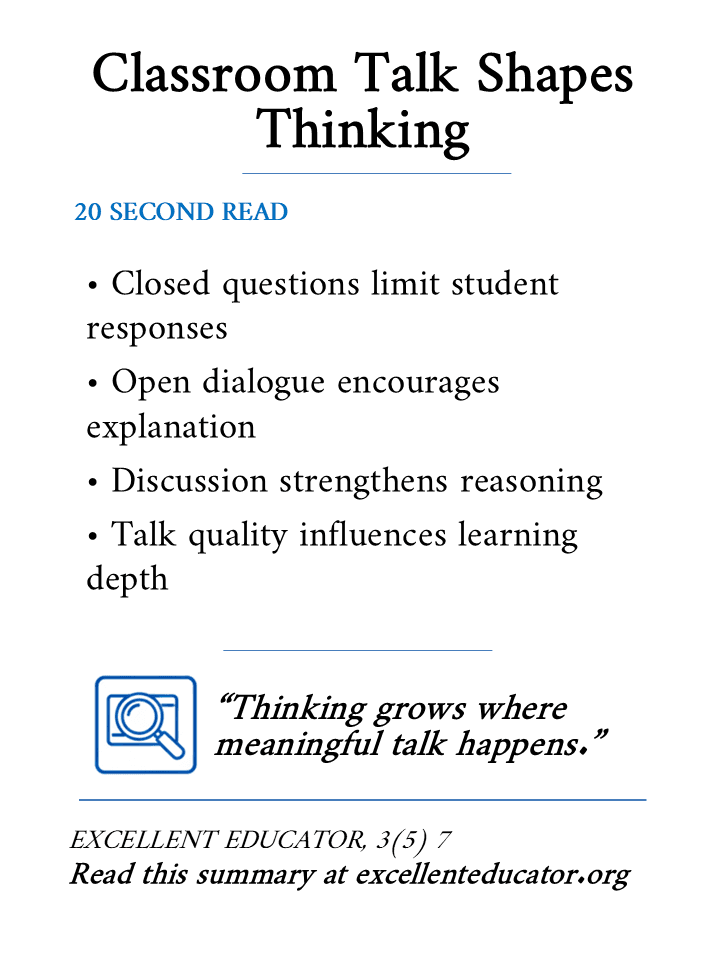
classroom talk shapes thinking

Why Do Classroom Innovations Often Stall?

WHY DO CLASSROOM INNOVATIONS OFTEN STALL? What New Research Says About Teacher Learning and Change Excellent Educator, 3(11), 15-16, 2026 WHAT RESEARCH FOUND Teachers often attend professional development programs yet struggle to sustain classroom change. Researchers studying teachers working with digital technologies found that teacher learning is influenced by many interconnected factors, including resources, relationships, […]

Why Do Classroom Innovations Often Stall? Read More »

classroom talk shapes thinking

Are Assessments Really Teaching?

ARE ASSESSMENTS REALLY TEACHING? What New Research Says About Hidden Messages in Assessment Excellent Educator, 3(11), 13-14, 2026 WHAT RESEARCH FOUND Researchers investigated how students interpreted messages communicated through assessment practices in a college science course. Students often concluded that success depended on producing instructor-approved answers rather than understanding ideas deeply. Assessment tasks, answer keys,

Are Assessments Really Teaching? Read More »

classroom talk shapes thinking

What Makes Students Want to Learn?

WHAT MAKES STUDENTS WANT TO LEARN? What New Research Says About Interest and Engagement Excellent Educator, 3(11), 11-12, 2026 WHAT RESEARCH FOUND A review of research identified six common factors that spark situational interest in learning: relevance, novelty, cognitive challenge, social interaction, hands-on activity, and choice. These factors increase attention, engagement, and persistence, while also

What Makes Students Want to Learn? Read More »

classroom talk shapes thinking

Can Faster Feedback Improve Learning?

CAN FASTER FEEDBACK IMPROVE LEARNING? What New Research Says About AI-Supported Peer Assessment Excellent Educator, 3(11), 9-10, 2026 WHAT RESEARCH FOUND Researchers examined whether automated corrective feedback combined with peer assessment could improve language learning. Students receiving AI-supported feedback achieved better learning outcomes, reported higher intrinsic motivation, and demonstrated stronger self-regulated learning beliefs than students

Can Faster Feedback Improve Learning? Read More »

classroom talk shapes thinking

Do Students Learn More With Choice?

DO STUDENTS LEARN MORE WITH CHOICE? What New Research Says About Meaningful Assessment Excellent Educator, 3(11), 5-6, 2026 WHAT RESEARCH FOUND Authentic assessment is often associated with real-world tasks. However, researchers found that students frequently valued something else even more: choice. In a study examining highly engaging assessments, students reported stronger engagement when they could

Do Students Learn More With Choice? Read More »

classroom talk shapes thinking

Why Do Students Avoid Critical Thinking?

WHY DO STUDENTS AVOID CRITICAL THINKING? What New Research Says About Building Cultures of Thinking Excellent Educator, 3(11), 3-4, 2026 WHAT RESEARCH FOUND Critical thinking is often described as an essential educational goal. Yet many students hesitate to engage in it, especially when problems lack clear answers. Researchers studying an active-learning university course found that

Why Do Students Avoid Critical Thinking? Read More »

classroom talk shapes thinking

Should Students Decide What to Practice?

SHOULD STUDENTS DECIDE WHAT TO PRACTICE? What New Research Says About Learner Control and Progress Tracking Excellent Educator, 3(11), 1-2, 2026 WHAT RESEARCH FOUND Many digital learning systems automatically decide what students should practice next. While this can improve efficiency, it may also reduce opportunities for students to develop ownership of learning. A recent study

Should Students Decide What to Practice? Read More »

Scroll to Top