collaboration

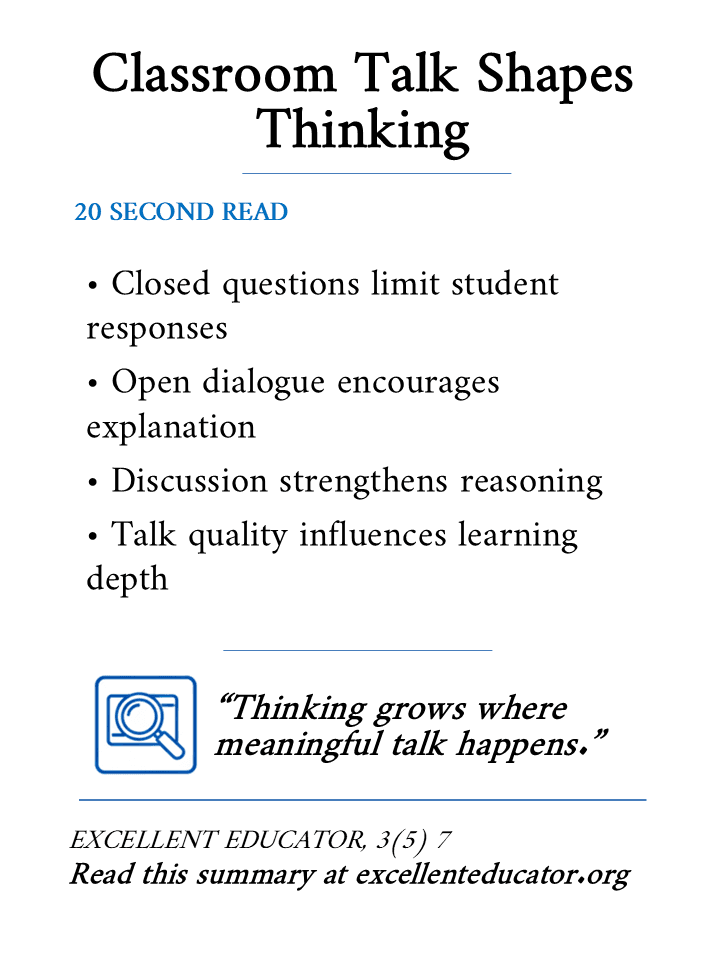
classroom talk shapes thinking

Home–School Partnerships in Rural Contexts

Home–School Partnerships in Rural Contexts Excellent Educator, Volume: 3, Issue: 8, Page: 7 Summary of Anazia et al. (2025) Academic Insights This study explores home-school partnerships in rural, disadvantaged settings, focusing on shared values and expectations. It identifies communication, shared responsibility, and collaboration as core principles. While both parents and teachers recognize these values, gaps […]

Home–School Partnerships in Rural Contexts Read More »

classroom talk shapes thinking

Strengthening Parent Roles in Inclusive Education

Strengthening Parent Roles in Inclusive Education Excellent Educator, Volume: 3, Issue: 8, Page: 5 Summary of Koskela and Sinkkonen, (2025) Academic Insights This study examines parental roles in inclusive education, particularly for students requiring additional support. It identifies varied parental experiences, including active partnership, passive participation, and resistance, depending on how schools engage them. While

Strengthening Parent Roles in Inclusive Education Read More »

classroom talk shapes thinking

Drama Education and Critical Thinking

Drama Education and Critical Thinking Excellent Educator, Volume: 3, Issue: 7, Page: 3 Summary of Hu and Shu (2025) Academic Insights Academic InsightsThis study explored how drama education can improve critical thinking through collaboration and communication. Survey and interview data from university students showed that teamwork and expressive interaction in drama activities had significant positive

Drama Education and Critical Thinking Read More »

classroom talk shapes thinking

Interactive Learning for Critical Thinking

Interactive Learning for Critical Thinking Excellent Educator, Volume: 3, Issue: 7, Page: 2 Summary of Blyznyuk and Kachak (2024) Academic Insights This article highlights how interactive learning strengthens students’ critical thinking by making them active participants in the learning process. Instead of passively receiving information, students engage in problem solving, discussion, collaboration, reflection, and practical

Interactive Learning for Critical Thinking Read More »

Scroll to Top