excellent_educator

classroom talk shapes thinking

Boredom Destroys Classroom Attention

Boredom Destroys Classroom Attention Excellent Educator, Volume: 3, Issue: 6, Page: 6 Summary of Zhao & Wang (2025) Academic Insights Every teacher has seen it—students staring out the window, drifting away from the lesson. This study explored the causes and consequences of boredom in language learning classrooms. The findings show that boredom often arises from […]
Boredom Destroys Classroom Attention Read More »

classroom talk shapes thinking

Teaching Beyond the Limits of Curriculum

Teaching Beyond the Limits of Curriculum Excellent Educator, Volume: 3, Issue: 6, Page: 7 Summary of Schultz et al. (2013) Academic Insights Teachers often feel trapped between strict curriculum requirements and meaningful learning experiences. This study introduces the idea of “teaching in the cracks.” Instead of abandoning the curriculum, teachers find opportunities within it to

Teaching Beyond the Limits of Curriculum Read More »

classroom talk shapes thinking

Teacher Support Fuels Student Engagement

Teacher Support Fuels Student Engagement Excellent Educator, Volume: 3, Issue: 6, Page: 7 Summary of Shao et al. (2025) Academic Insights Why do some students stay deeply involved in learning while others withdraw? This study highlights the powerful role of teacher support. When teachers provide encouragement, clear guidance, and emotional support, students develop stronger confidence

Teacher Support Fuels Student Engagement Read More »

classroom talk shapes thinking

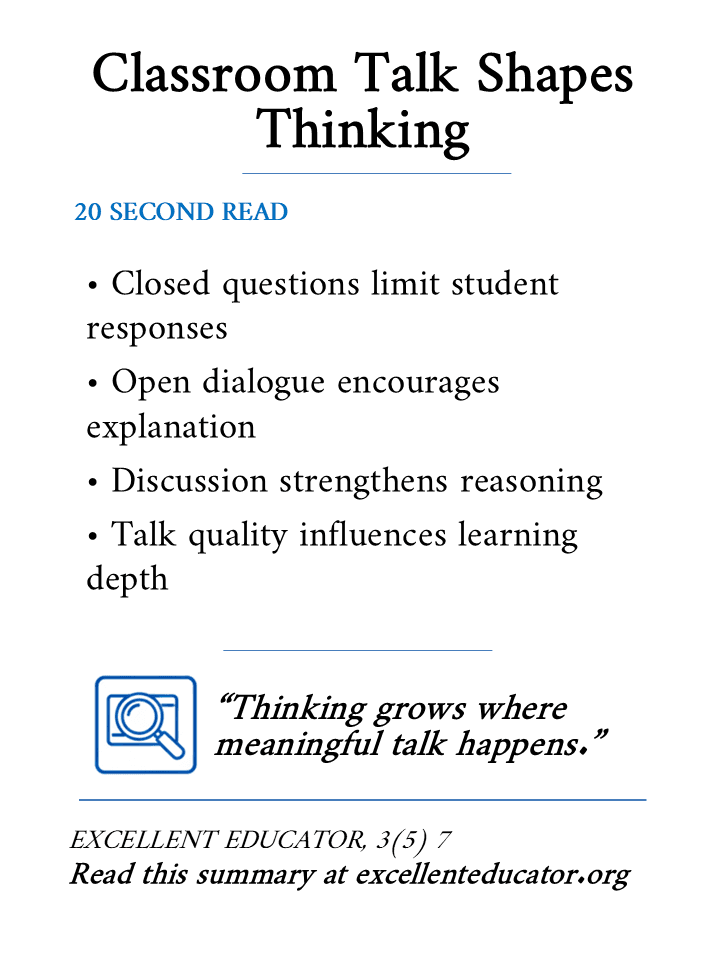
Classroom Talk Shapes Thinking

Classroom Talk Shapes Thinking Excellent Educator, Volume: 3, Issue: 5, Page: 7 Summary of Thompson et al. (2025) Academic Insights This summary highlights the influence of classroom talk patterns on student thinking and participation. According to the researchers many lessons are dominated by teacher instructions and closed questions, leading to brief, low-level student responses. In

Classroom Talk Shapes Thinking Read More »

emotional support drives engagement

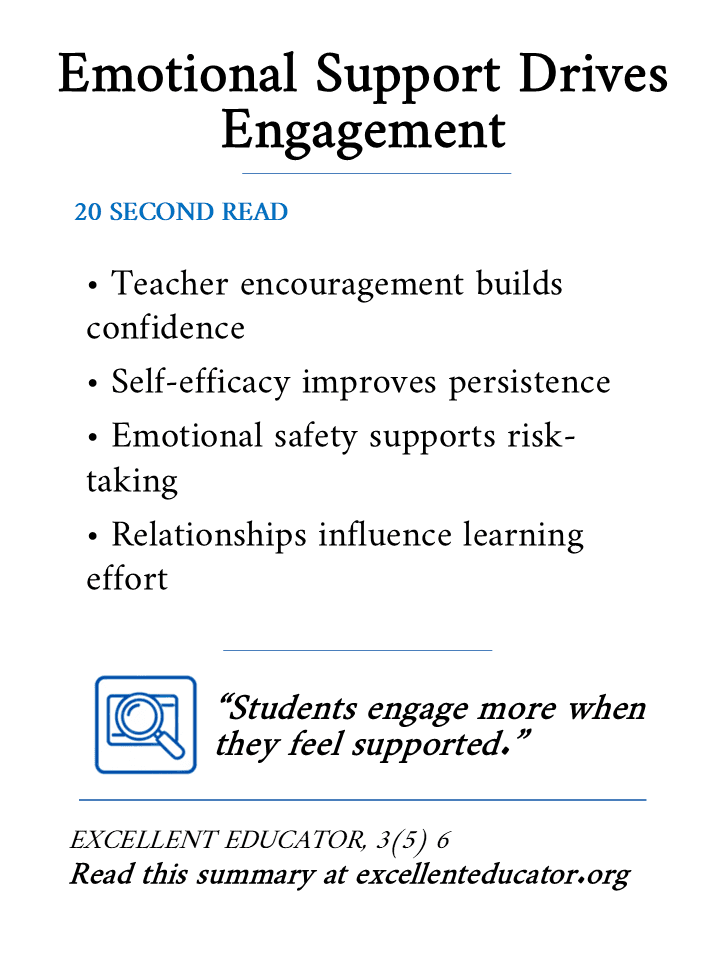
Emotional Support Drives Engagement

Emotional Support Drives Engagement Excellent Educator, Volume: 3, Issue: 5, Page: 6 Summary of Guo et al. (2025) Academic Insights This summary explains how teachers’ emotional support strengthens student engagement by building academic self-efficacy and resilience. According to the researchers when students feel encouraged, understood, and supported, their confidence in handling academic tasks increases. Higher

Emotional Support Drives Engagement Read More »

address misconceptions for understanding

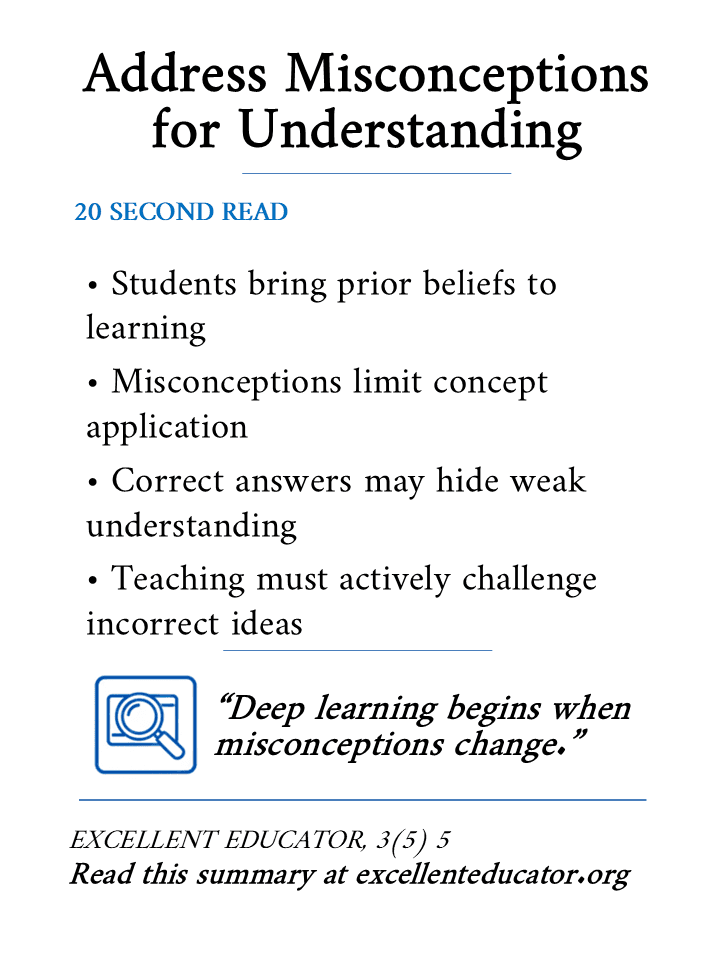
Address Misconceptions for Understanding

Address Misconceptions for Understanding Excellent Educator, Volume: 3, Issue: 5, Page: 5 Summary of Salame et al. (2025) Academic Insights This summary highlights how students’ prior misconceptions can limit deep conceptual understanding in science learning. According to the researchers many learners rely on everyday reasoning rather than scientific explanations, which affects their ability to apply

Address Misconceptions for Understanding Read More »

balance matters in inquiry

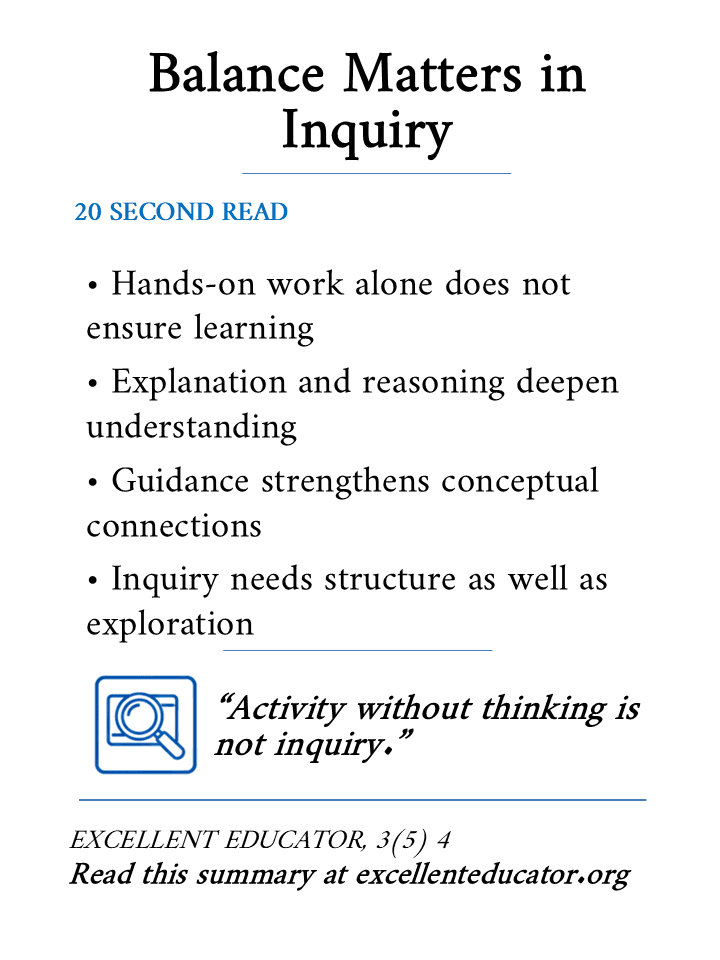
 Balance Matters in Inquiry

Balance Matters in Inquiry Excellent Educator, Volume: 3, Issue: 5, Page: 4 Summary of Morris (2025) Academic Insights This summary explains the need to move beyond activity-focused inquiry toward balanced, comprehensive inquiry-based instruction. According Morris (2025) many classrooms equate inquiry with hands-on experiments while neglecting essential phases such as reasoning, explanation, and scientific argumentation. When

 Balance Matters in Inquiry Read More »

teacher beliefs shape inclusion

 Teacher Beliefs Shape Inclusion

Teacher Beliefs Shape Inclusion Excellent Educator, Volume: 3, Issue: 5, Page: 3 Summary of Woodcock & Anderson (2025) Academic Insights This summary examines how teachers’ understanding of inclusion influences classroom practice and student participation. According to the researchers mostly educators generally support inclusive education, uncertainty about implementation often leads to inconsistent practices. Teachers’ beliefs about

 Teacher Beliefs Shape Inclusion Read More »

Scroll to Top