
When Questions Become a Thinking Method
The deepest shift may be from answering questions to creating them.
Excellent Educator, 3(16), 7-8, 2026
🧠 Research in Brief
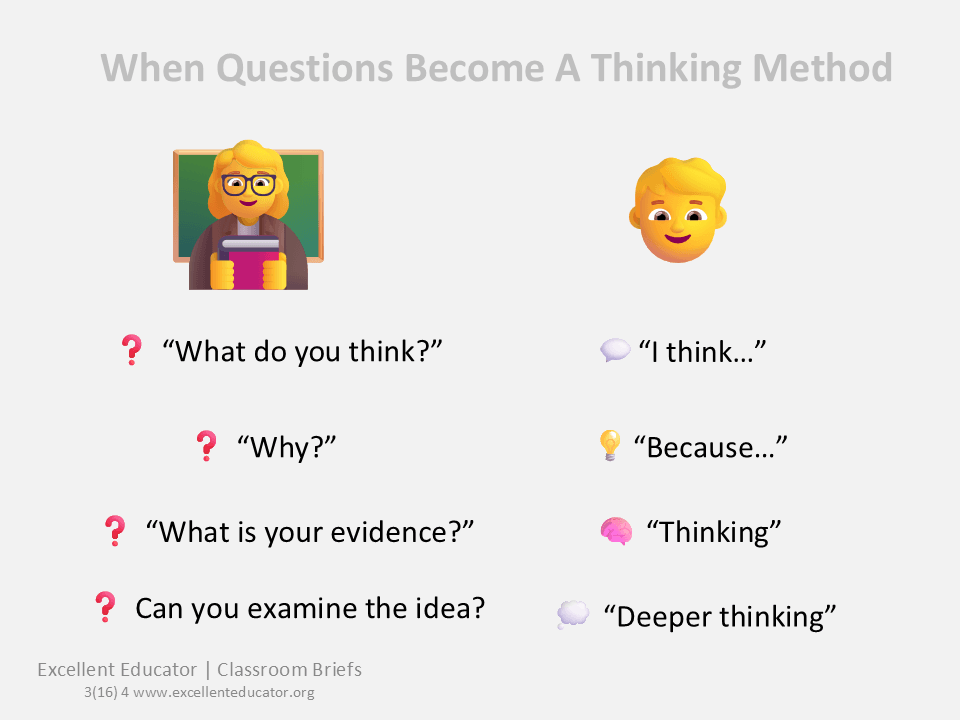
The Socratic method is based on teaching through questions and discussion rather than simply telling students what to know. The paper describes it as teaching by asking instead of telling, with the aim of guiding students toward greater understanding and critical thinking.
A study involving young children used a Socratic-method programme built around structured questioning and discussion. The researchers reported development in children’s critical-thinking behaviours. The approach encouraged children to explain ideas, reconsider their thinking and engage actively in discussion.
However, the research also identifies a practical caution: young children may become bored or have difficulty with the method when it is used in isolation. The authors therefore suggest integrating Socratic questioning with active activities.
✔ Try Tomorrow
Choose one student answer and do not evaluate it immediately.
Instead ask:
- Why?
- What makes you think so?
- What evidence do we have?
- What might someone who disagrees say?
★ One Key Takeaway
The teacher’s most powerful question may sometimes be the question that follows the student’s answer.
Keywords
Socratic questioning, critical thinking, classroom discussion, reasoning, questioning strategies, student thinking
📖 Original Research
Kanat, K., & Temel, Z. F. (2025). The use of questioning strategies in the development of critical thinking skills in children: A qualitative study of the Socratic method. Early Childhood Education Journal, 53, 3063–3073.