
The Power of a Silent Pause in Questioning
Sometimes the best response to a question is to wait.
Excellent Educator, 3(16), 3-4, 2026
🧠 Research in Brief
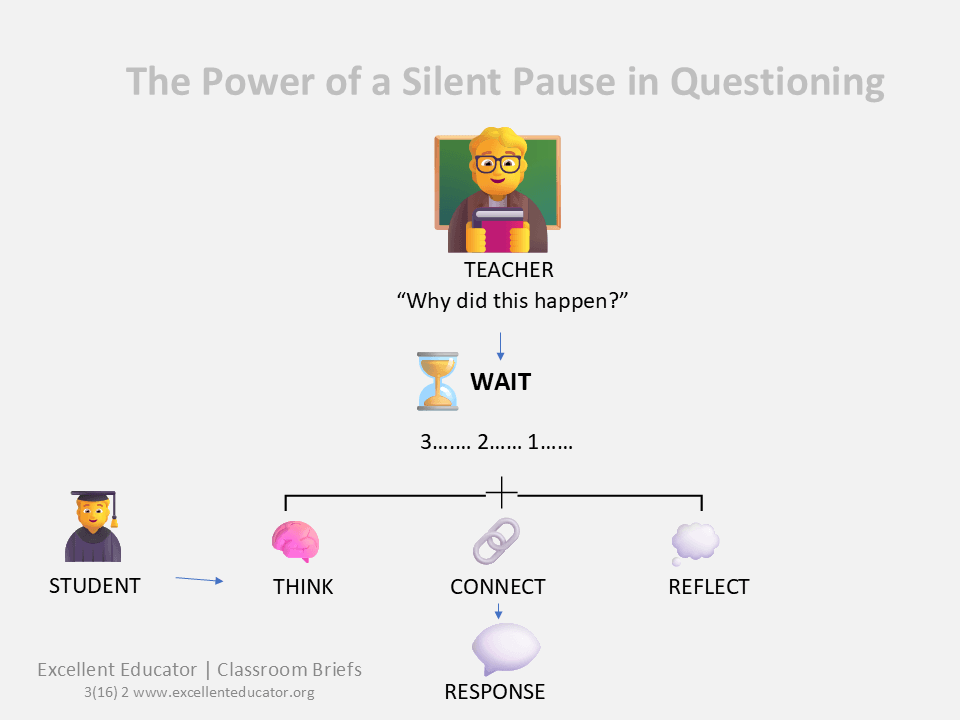
Research on questioning shows that students often need more time than teachers naturally give them. Yet extending the pause has been associated with longer student responses, increased student talk, greater exchange of ideas, more volunteered responses and less teacher talk.
An important finding is that adults do not necessarily wait longer for more cognitively demanding questions. In several studies, children received the same—or even less—time to answer higher-level questions than simpler ones. This matters because open-ended and higher-level questions generally require more processing.
The evidence therefore points to a simple classroom practice: do not ask a difficult question and immediately rescue students from the silence.
✔ Try Tomorrow
- Ask a challenging question.
- Pause before selecting anyone to answer.
- Let students think individually before discussion.
- Notice who contributes when you stop filling the silence.
★ One Key Takeaway
If we want better answers, we may first need to give students more time to think.
Keywords
Wait time, questioning, student talk, cognitive processing, classroom discourse, teacher talk
📖 Original Research
Shiau, A. Y. A., McWilliams, K., & Williams, S. (2024). The Role of Wait Time During the Questioning of Children: A Systematic Review. Trauma, Violence, & Abuse.in Brief